
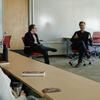
Dr. Alan McPherson (R) discusses his latest book with respondent Joseph Johnson (L).
Photo by Oliver Lois Economidis
In the introduction to his latest book, The Breach: Iran-Contra and the Assault on American Democracy, Dr. Alan McPherson, Temple professor of history and Director of CENFAD, references a line from the streaming sitcom Only Murders in the Building. Steve Martin’s character, summing up the Iran-Contra affair to a younger cohort, describes it as “worse than Watergate, just less interesting.”
On Feb 3, the Center for the Humanities at Temple (CHAT) hosted a celebration for the release of The Breach. McPherson worked on the book as a 2022-23 CHAT Fellow. Over the course of his presentation, McPherson discussed his motivation for writing the book and why the fallout of Iran-Contra still reverberates in America today, despite its relative obscurity—as moderator and Temple History PhD candidate Joseph Johnson noted, “It’s not all that popular in terms of national scandals.”
“If you think of it as a major step along a path of damage done to American democracy from the inside, it’s a whole other kind of scandal,” explained McPherson.
The Iran-Contra scandal refers to a series of foreign policy decisions made covertly under President Ronald Reagan. In the early 80s, Reagan’s administration dealt arms to Iran in hopes of freeing U.S. hostages being held by Iran-backed militants in Lebanon. The profits from these sales were then diverted to the Contras, an anti-communist insurgency group in Nicaragua.
As the scandal became public, officials routinely withheld information from congressional investigations and the press. While there were indictments for some who had either had a hand in the scheme or lied to Congress in its aftermath, most amounted to very little. In 1992, George H.W. Bush, who served as Vice President under Reagan, pardoned any outstanding convictions related to the scandal. “At least Watergate ended with a punishment,” noted McPherson.
In The Breach, McPherson frames the scandal through six aspects of democracy that were either violated or exploited: the rule of law, separation of powers, truth and transparency, privatization of foreign affairs, obstruction of justice, and quid pro quo dealings.
“My goal was not to say Iran-Contra touches on every tenet of democracy, but it touches enough of them that it could be understood as a broad assault on democracy,” explained McPherson.
McPherson argued that the real measure of Iran-Contra’s impact exists in the lingering cracks it left in our democracy. Illustrating that point, he pointed to President Donald Trump’s 2019 impeachment, related to alleged quid pro quo arrangements the president had made with Ukraine.
“He was impeached, but the Senate essentially said, ‘We’re not going to investigate this, we’re not going to respond, and we’re going to obstruct justice in every way we can,’” he said. “The process of burying the scandal seems the same. It sounded a lot like the way Congress handled Iran-Contra.”
The Breach: Iran-Contra and the Assault on American Democracy is available now. You can learn more about the book here.