
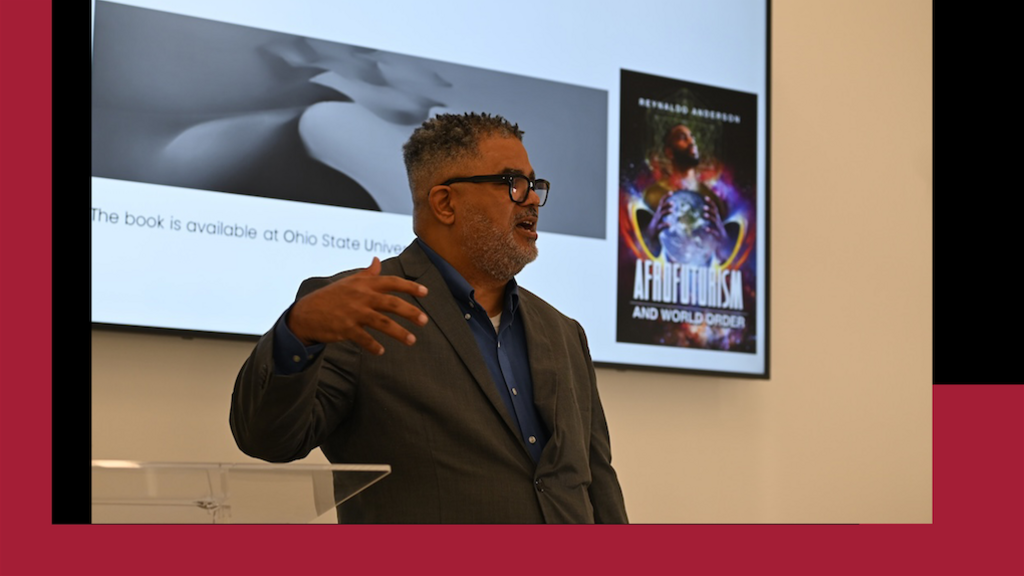
What can the past teach us about building the future? This question guided Dr. Reynaldo Anderson’s presentation on his book, Afrofuturism and World Order, as part of CHAT’s 2026–2027 Materialities programming.
Drawing on family histories rooted in Mississippi, African diasporic traditions, music, literature, and political thought, Anderson traced the foundations of contemporary Afrofuturism. From formerly enslaved ancestors to the blues music of his childhood, he explored how knowledge travels across generations, geographies, and cultural forms, offering resources for imagining different futures.
Anderson also emphasized that Afrofuturism extends beyond science fiction and aesthetics to encompass philosophy, science, technology, social inquiry, and community-based cultural production. His work with the Black Speculative Arts Movement demonstrates how scholarship and creative practice can move beyond university classrooms into public spaces, becoming tools for education and collective action. His scholarship further emphasizes the importance of building intellectual frameworks, artistic practices, and networks that center African and African diasporic agency. Anderson has shared this research with international audiences, including at the University of Bayreuth, the Oxford Symposia, and the University of Edinburgh.
Connecting his research to Temple’s Intellectual Heritage (IH) curriculum, Anderson highlighted the value of a broad humanities education. He pointed to Octavia Butler’s Parable of the Sower as a timely text for considering political instability, technological change, and imagined futures. Reading across historical periods and intellectual traditions, he suggested, equips students to recognize and critically engage the ideas shaping contemporary political discourse.
Ultimately, Anderson invited us to consider Afrofuturism as both an intellectual framework and a practical project: How can we draw on ancestral knowledge to build more equitable futures?