
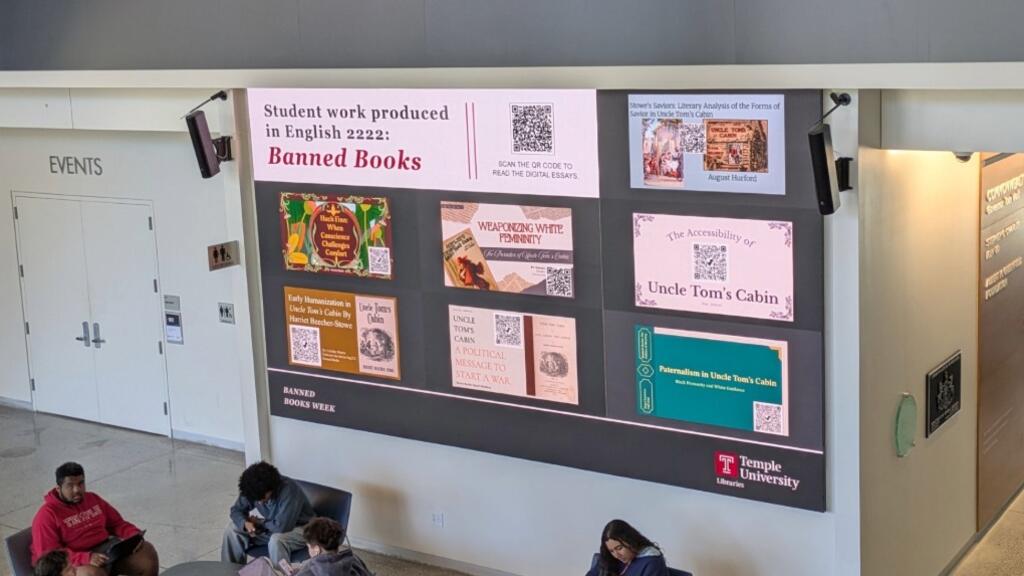
This year, Banned Books Week ran from October 4 to October 10. Established in 1982, the annual event aims to push against increasing challenges to books in libraries, bookstores and schools, and recognize the value of free and open access to information and literature. To help celebrate the week, the Charles Library displayed presentations on historic banned books, courtesy of students in Sue-Im Lee’s Banned Books: The Politics of Reading (ENG2222) course.
The project coincided with the students covering two foundational nineteenth-century books Lee chose to begin the semester with: Mark Twain’s The Adventures of Huckleberry Finn and Uncle Tom’s Cabin by Harriet Beecher Stowe.
“They were heavy lifting, because they’re massive novels,” notes Lee, an associate professor in the English Department. “That was the challenge I wanted to put to the students for their first two novels. Most of them are there because they believe books should not be banned—but what happens when you read a book that really can be offensive?”
The goal of each project was to offer a fresh perspective on the contradictory significance of these novels to an outsider. Uncle Tom’s Cabin is recognized today as an influential text in ending slavery in America, and The Adventures of Huckleberry Finn is a staple in the canon of great American literature, but both books have been regularly challenged over the years for some extreme cases of racist language. “They can be hard to read without wincing,” notes Lee.
The students tackled the task capably. A presentation by Bri Hansen examines Uncle Tom’s Cabin’s use of white femininity as its moral center rather than the experience of the novel’s enslaved characters—an approach that was effective in influencing audiences but harmful in minimizing the novel’s picture of Black life. Mekhi Shade’s “Huck Finn: When Conscience Challenges Comfort” breaks down the themes of Twain’s novel to clarify how the text’s depiction of hateful language and behavior is important to revealing the protagonist’s moral conflict and development.
This is Lee's first year teaching the English Department’s Banned Books course, and she recognizes that each instructor brings their own angle to the course’s overarching theme.
“My own approach starts from the course’s subtitle, ‘Politics of Reading,’” Lee explains. “If the meaning lies in the book, why does it change throughout history? If it lies in the words themselves, why do people who read the same words come away with different interpretations, one saying it ought to be banned because it’s dangerous and another saying it’s very important?”
If enrollment is any indication, questions like these seem to be resonating with a wide range of students.
“This course has the most varied mix of majors I’ve ever had in an English course,” says Lee. “Most of my classes are English majors, but this one has psychology, history, dance, journalism, communications, fine arts, film…I’ve never had a course like this, and I think it’s the topic.”
You can see each of the presentations that ran on the Charles Library screens here. The presentations included were:
- “The Accessibility of Uncle Tom’s Cabin” by Kay Jabrun
- “Uncle Tom's Cabin: A Political Message to Start a War” by Annaliese Bach
- “Early Humanization in Uncle Tom's Cabin” by Caroline Maurer
- “Huck Finn: When Conscience Challenges Comfort” by Mekhi Shade
- “Paternalism in Uncle Tom's Cabin” by Meg Charleton
- “Stowe's Saviors: Literary Analysis of the Forms of Savior in Uncle Tom's Cabin” by August Hurford
- “Weaponizing White Femininity” by Bri Hansen