
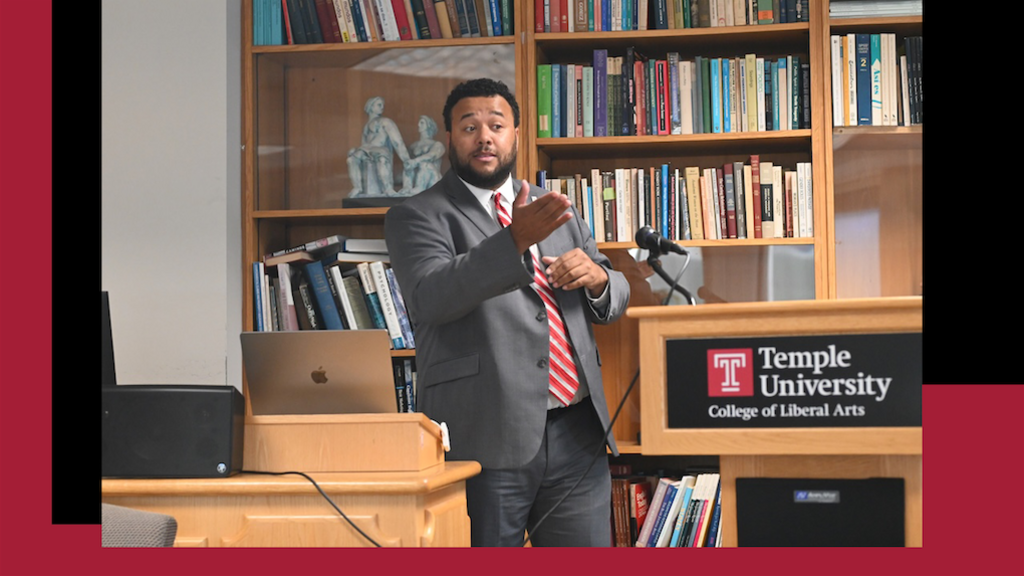
Did Black men become more conservative and vote for Donald Trump in the 2024 presidential election? This provocative question anchored CHAT Faculty Fellow Dr. Nyron Crawford’s presentation, Precariat: The Political Economy of Black Men.
Drawing on political science, political economy, electoral data, and popular culture—from Kamala Harris’s campaign appearances and Pop the Balloon to podcasts and televised political commentary—Crawford unpacked the narratives surrounding Black male voters before and after the 2024 election. Are Black men realigning with Republicans? Have their policy preferences become more conservative? Or are we asking the wrong questions?
Crawford challenged these assumptions by shifting attention to the material realities of Black men’s political lives, particularly the intersection of race, class, and the carceral state. Disproportionate incarceration, felony disenfranchisement, costly expungement processes, and persistent barriers to employment shape not only political participation but also trust in the institutions that claim to represent Black men. Even policies framed as advances in racial justice, such as marijuana legalization, raise difficult questions when they fail to address the lasting consequences of criminal records.
Drawing on data from the Black Voting Project, Crawford emphasized the importance of distinguishing between who votes, who can vote, and how political preferences are interpreted. Rather than attributing electoral outcomes to the gender or racial identity of a particular candidate, he asked us to consider the Democratic Party’s longer history of engagement—or disengagement—with Black men. He also explored how political alienation can create openings for the manosphere, where grievances find expression in narratives that can veer toward conspiracy theories and political misinformation.
Ultimately, Crawford invited us to move beyond simplistic explanations of electoral realignment and ask more consequential questions: What problems need to be solved? Who is listening? And how are political institutions responding?
We look forward to seeing how these questions develop in Crawford’s next book project, following his 2024 publication, Marked Men: Black Politicians and the Racialization of Scandal (New York University Press).