
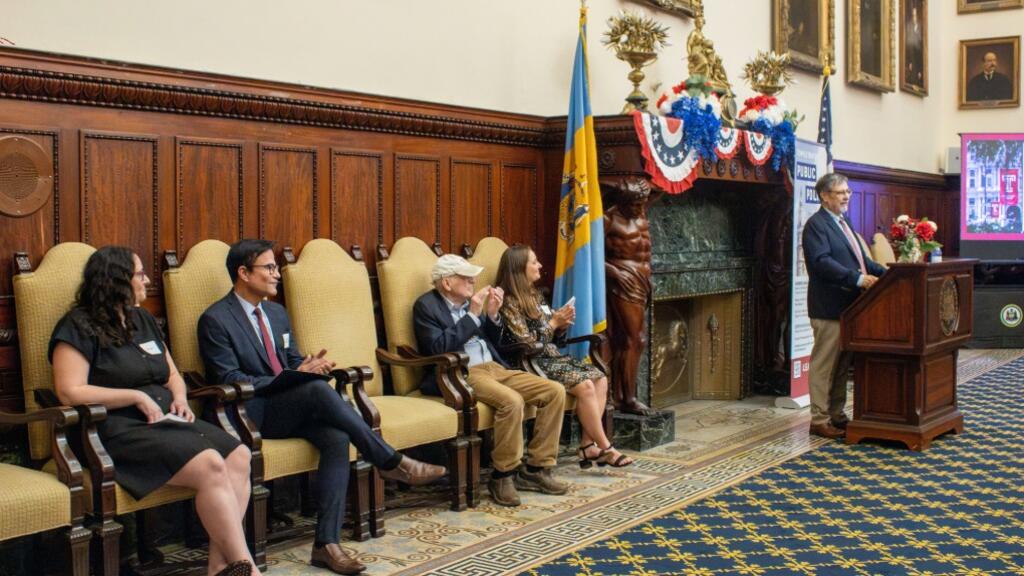
(L to R) Elise Chor, Hiram Aldarondo, Joseph McLaughlin, Kasey Trapp, Gary Mucciaroni
Photo by Elliet Schriver
On November 6, at Philadelphia’s City Hall, Temple University’s Master of Public Policy program celebrated ten years of training future generations of policy professionals and changemakers. Guests convened in the Mayor’s Reception Room for refreshments and remarks from a handful of the people responsible for the MPP program’s first decade of success.
“When the college first considered the development of this MPP program, they saw an opportunity, but also a responsibility,” said Senior Associate Dean of Academic Affairs Hiram Aldarondo. “As a major public university located in Philadelphia, Temple occupies a distinctive position: We are part of a city and a region facing complex challenges, but also offering great opportunities.”
Judging by the number of alumni in public service roles in attendance, as well as the policy professionals who have employed so many of them, the college has lived up to that responsibility. Over its decade of existence, the program has carved out a meaningful role in how the city operates and serves its residents.
In her remarks, MPP Director Elise Chor touted the program’s meaningful partnerships with organizations across Philadelphia, including soon offering city employees discounted tuition in the MPP program. As noted by Joseph McLaughlin, former political science professor and founding MPP faculty member, the Philadelphia School District’s recently implemented Handle With Care program, designed to support students who have experienced trauma outside of school, began as an MPP capstone project.
“One of my closest friends in public policy used to say, ‘I learned one hundred ways to analyze a problem and not a single way to change policy,’” said McLaughlin. “The fact that we were based in the Political Science Department has given us this focus on teaching how to change policy. That’s what the capstone is about.”
Gary Mucciaroni, professor emeritus in the Political Science Department, was tasked with developing the program from the ground up ten years ago. Initially, the university planned to locate the program in Harrisburg, but as Mucciaroni explained, proximity to the heart of the city was always integral to the program’s success.
“The audience for the program was always here,” said Mucciaroni. “This is where the jobs are for people who are designing, implementing and evaluating these programs.”
Though Mucciaroni stepped down as program director in 2025, he remains supremely confident in what lies ahead for the program under his successor, Elise Chor.
“Today there are more highly dedicated, talented and professionalized faculty and staff at Temple than the day I arrived, and that makes me assured that the program will succeed,” said Mucciaroni. “And of course, we now have a couple hundred alumni who are out there as ambassadors, recruiting for us and telling everybody how wonderful the program is.”