
This Hispantic/Latinx Heritage Month, the Spanish & Portuguese Department, along with Temple Libraries, came together to celebrate the many connections between Temple and Peru.
Across this slate of events, artists, scholars and practitioners from across Temple and beyond explored Peru through art, engineering, architecture, public health, photography, sculpture, film, history and more—showcasing the extraordinary ways our communities, research and creative practices cross borders.
From building sustainable water systems in Peru to exploring Lima’s built environment, from contemporary Peruvian art to public health initiatives and histories of the Inca Empire, this year's theme, Perú en Temple | Temple en Perú, brought together the many ways Peru is already part of Temple. The series was organized by Dr. Sergio Ramírez Franco in collaboration with Temple Libraries.
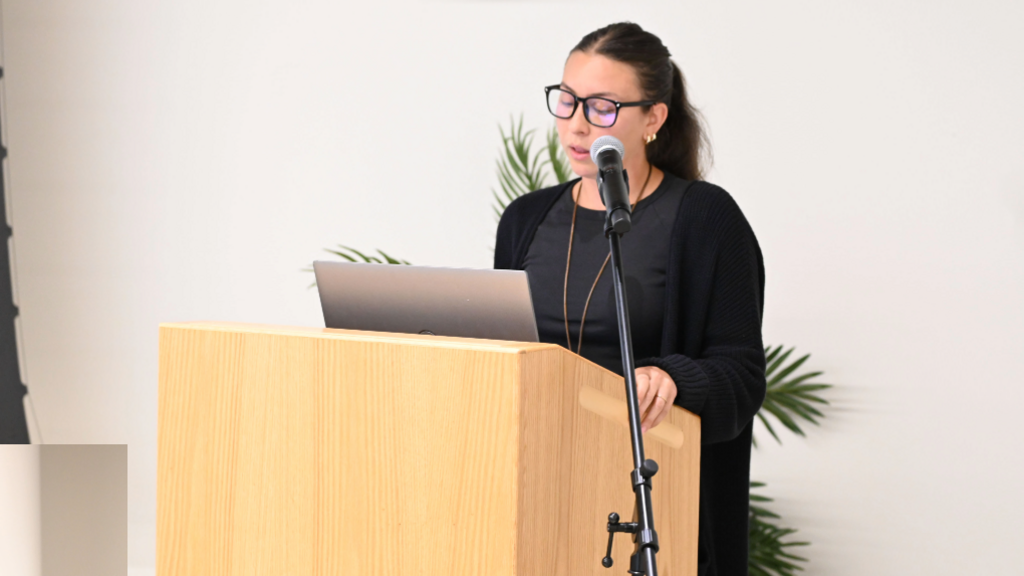
Romina Broglia at the Charles Library Event Space
On September 16, 2026, Romina Broglia (TYL ‘26) gave a riveting talk about the Muro de la Vergüenza, a dividing line between those with resources and those without, a line that further stigmatizes and disenfranchises specific populations in Lima, Peru. As an architect, she proposed what it would mean to reimagine the space as a “multifunctional infrastructure, rather than a single-purpose barrier.” To do so, however, would require starting “from the ground itself, not from a rendering.” At the core of her proposal was a return to the ways in which Inca populations centuries ago utilized natural land structures to create water-flow patterns, improve air quality, and create agricultural sites ripe with possibility.
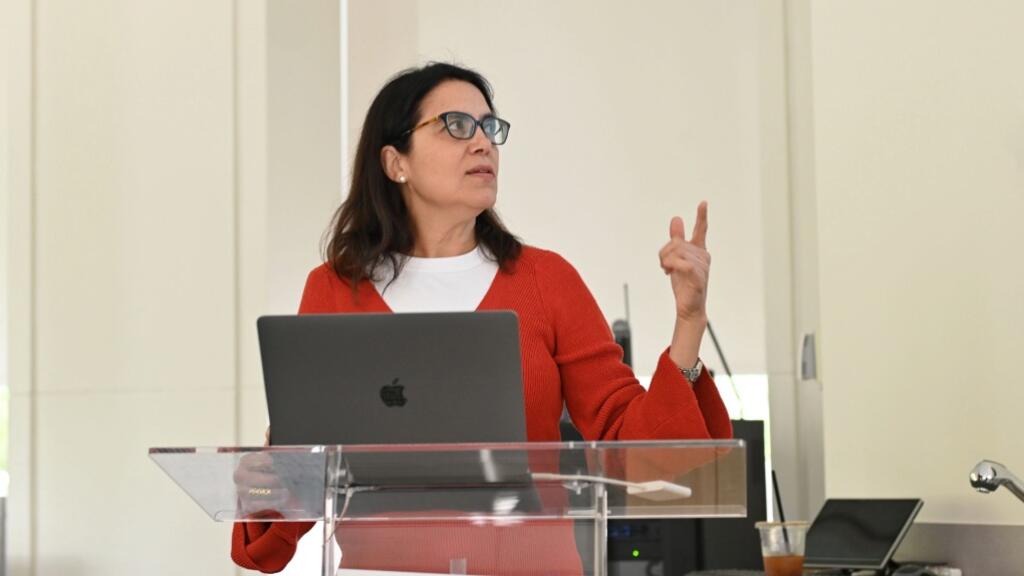
Monica Ricketts delivers her presentation at Mazur Hall
On September 24, Dr. Mónica Ricketts (History) presented Intermixing in the Conquest to an audience of approximately 40 students. Drawing on Jeremy Ravi Mumford’s research on child marriage in early colonial Cuzco, Ricketts explored the conquest of Peru through the intertwined histories of Indigenous identity, gender, familial violence, and colonial power. Focusing on Beatriz Coya, a wealthy Inca heiress who was forced into marriage as a child, Ricketts demonstrated how marriage became a mechanism through which Spanish colonizers pursued wealth, political alliances, and control over Indigenous populations. Her presentation encouraged students to move beyond abstract narratives of conquest to consider how colonial violence operated at the most intimate level, such as through families, bodies, sexuality, and the law.
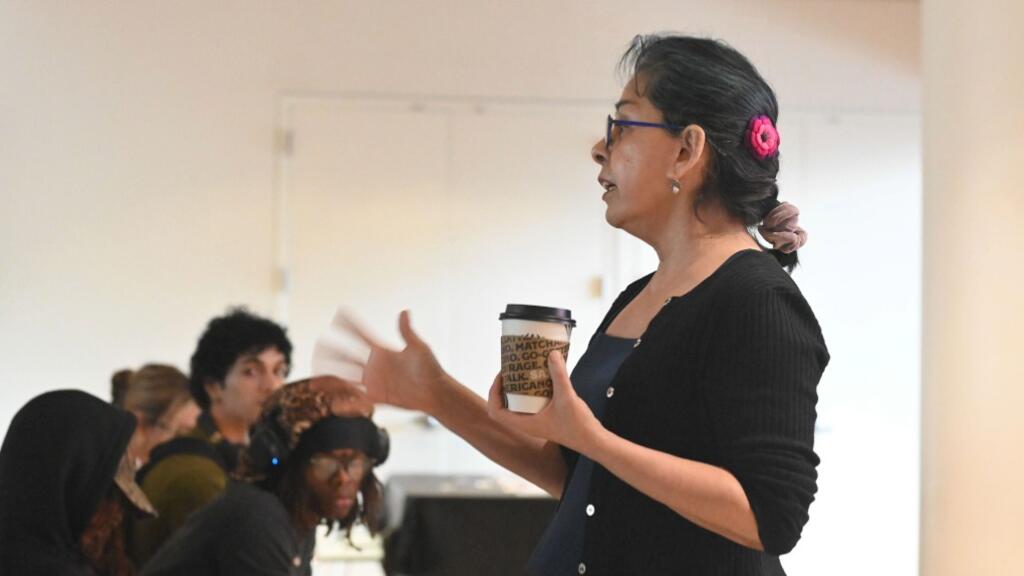
Kukuli Velarde discusses her work for guests at Charles Library
Speaking before an audience of more than 60 people, artist Kukuli Velarde’s In Search of An Aesthetic of My Own shared a practice that explores histories of colonization, cultural survival, and reclamation through works deeply informed by Indigenous traditions of the Americas. Her work challenges the ways Indigenous objects and bodies have been classified, displaced, and displayed. Drawing on Pre-Columbian forms, colonial religious imagery, and the syncretism produced through centuries of cultural encounter, Velarde considers survival as at once personal, communal, and historical.
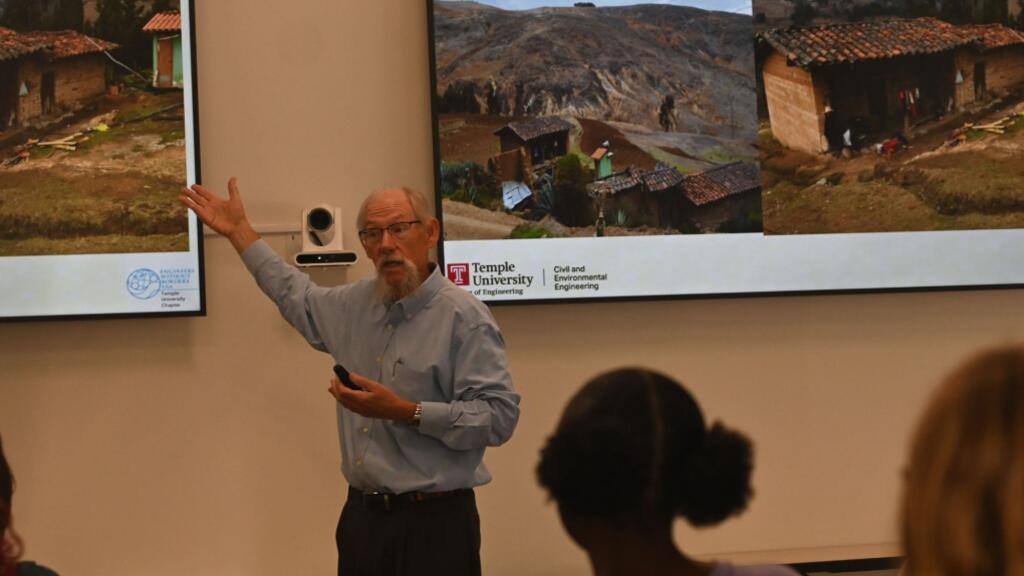
Dr. Robert J. Ryan discusses Temple's work in Peru with Engineers Without Borders.
In his presentation, Water For Saacha: Temple Engineering in Peru, Dr. Robert J. Ryan (College of Engineering) offered a portrait of life in the rural farming community of Saacha, Peru, where subsistence agriculture relies on an extensive irrigation network carrying river water across steep mountainous terrain. Despite considerable local knowledge and infrastructure, however, residents lack reliable access to drinking water. Ryan emphasized that addressing this challenge required more than an engineering solution. Residents had experienced election cycles marked by promises of improved infrastructure that often went unfulfilled, making trust especially important when outsiders proposed another project.
The work of Engineers Without Borders and Temple participants was rooted in sustained community collaboration: listening to residents, learning from existing practices, and building relationships before determining appropriate interventions. The team asked not only how residents currently used water, but what greater access might allow them to do. In this way, the project approached engineering as a collaborative process shaped by community knowledge, priorities and possibilities.
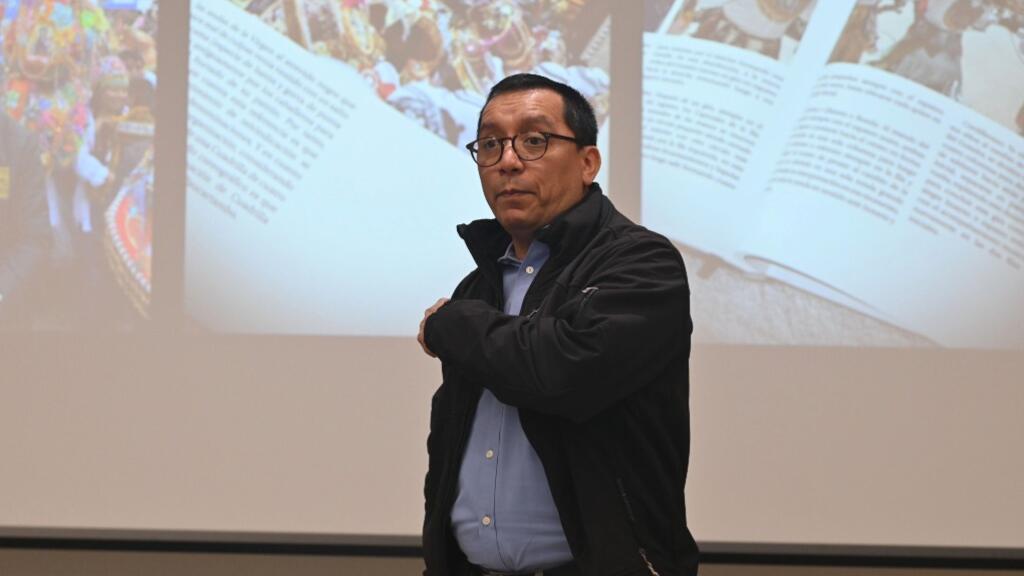
Dr. Dilmar M. Gamero S. at the Charles Library Event Space
On October 7, 2026, Dr. Dilmar M. Gamero S. (Tyler School of Art and Architecture) presented Bridges, a reflection on his artistic practice and personal journey from Peru to Temple University. Tracing his early experiences photographing rural communities in Peru, Gamero described his growing understanding of photography as a tool for social engagement and transformation. He also reflected on the power of the camera and the ethical responsibilities of an artist who determines what—and whom—to represent.
Through striking photographs of religious pilgrimages and the Mamacha Carmen celebrations in Paucartambo, Gamero examined the complex intersections of Indigenous Andean traditions and Catholicism. Using bridges as both a physical and metaphorical thread, Gamero encouraged guests to think about how photography can shape relationships with communities, cultural traditions, and spirituality.
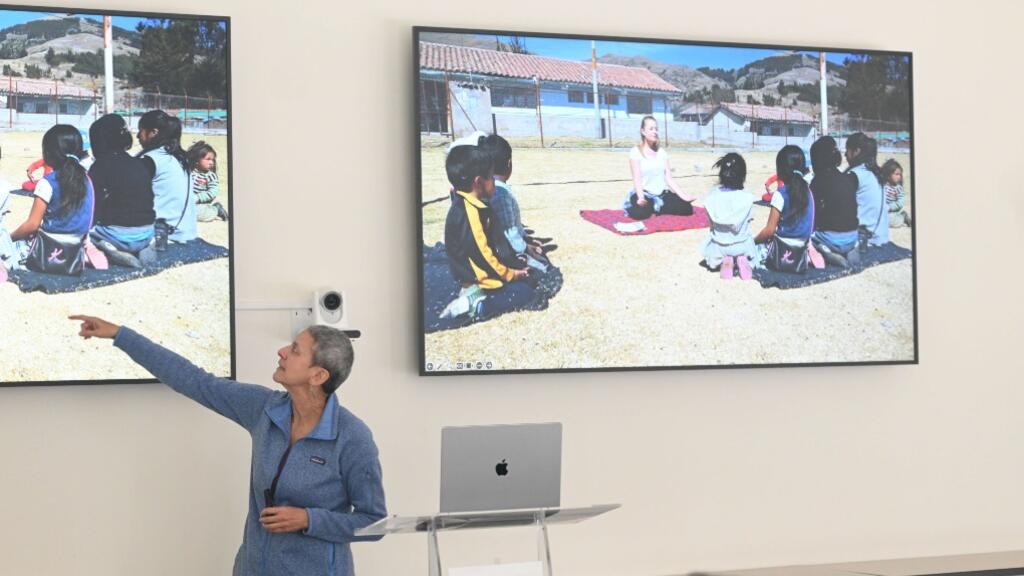
Dr. Graciela Jaschek at Mazur Hall's first floor event space
On October 12, 2026, Dr. Graciela Jaschek (College of Public Health) recounted her experiences with Public Health Beyond Borders. Dr. Jaschek emphasized how global learning experiences empower students to develop cultural awareness, critical thinking, leadership and problem-solving skills. Through hands-on projects in countries such as Peru, we learned how Temple students engage with communities to address public health challenges and discover the importance of cultural understanding.
From teaching yoga to Peruvian children to researching water safety and community health behaviors in Spanish, students learn to adapt, communicate and lead with empathy. These experiences encourage independence, meaningful reflection and professional growth while connecting classroom knowledge to real-world challenges.
Other Hispanic/Latinx Heritage Month goings-on...
- Until November 13, visitors to the 4th floor of Charles Library have the opportunity to check out Lightness and Movement, an exhibit made up of artifacts from the Kaxinawá, an indigenous group residing in the Amazon rainforest in both Peru and Brazil. The collection comes on loan from the Temple Anthropology Laboratory & Museum. You can learn more about the exhibit at the Temple University Libraries page.
- The Department of Spanish & Portuguese's ciclo de cine hosted a screening of Wiñaypacha, the first Peruvian film shot entirely in the indigenous Aymara language. Written and directed by Óscar Catacora, Wiñaypacha (Eternity) tells the story of an elderly couple named Willka and Phaxsi (Sun and Moon) living in a remote part of the Andes Mountains.