
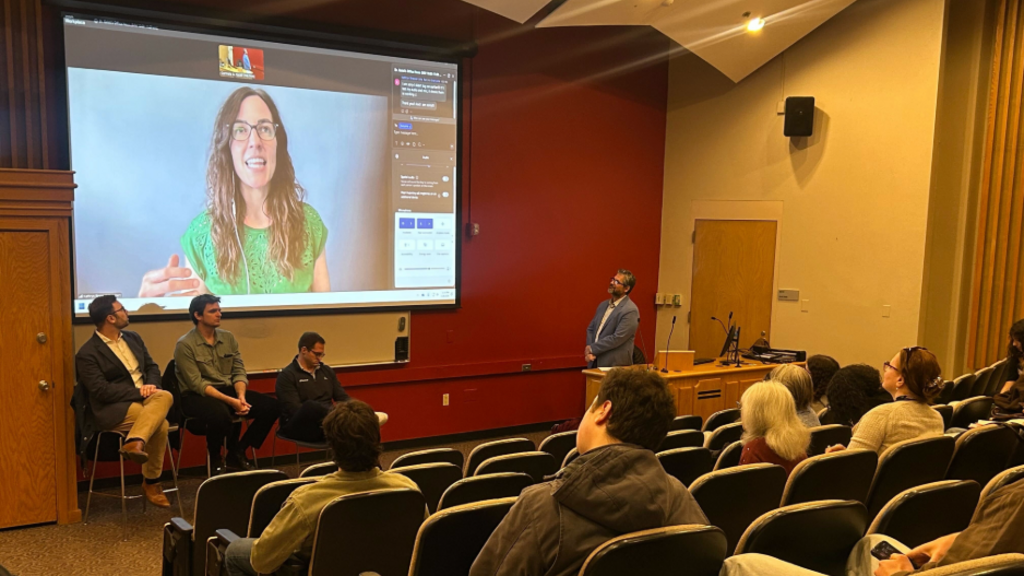
(L to R) Panelists Louis Pera, Max Marin and Peter Mackar, with moderator Carnelo Galati. Kathryn Strasser participated remotely.
The Modern Languages, Literatures and Cultures; Spanish and Portuguese; and Greek and Roman Classics Departments came together on April 8, 2026, to present a special Language Majors at Work panel at Mazur Hall.
The event, moderated by Italian Professor Carmelo Galati, brought together a panel of four alumni who majored in language studies while they were at Temple. While the panelists have all embarked on very different career paths, each agreed that their respective language studies were formative in where they landed.
Kathryn Strasser, CLA ‘06, is a contributing author and editor with Wayside Publishing, and prior to that, she taught high school Spanish for 13 years. Strasser was a dual Spanish and anthropology major who fell in love with the study of language while participating in Temple’s Latin American Studies Semester. During that year’s trip to Mexico, Strasser was struck by how much her understanding of the language enriched her experience.
“With modern languages, it just goes so far beyond the words on the page,” said Strasser. “History comes alive, food comes alive. Culture informs language; it informs the perspective of language. It just became a part of me and how I see everything.”
A similar global and cultural curiosity proved to be a valuable asset to other panelists. Louis Pera, CLA ‘17, studied Italian and Spanish at Temple, including semesters in Rome and Spain.
“My first job out of undergrad was with an immigration law firm,” explained Pera. “We worked entirely in English, but they wanted you to be invested in the field. I studied in Italy and Spain, and I had experience being outside my home country for an extended period—for me, that was my connection.”
Today, Pera is an associate attorney at Fox Rothschild. Through his career, his language study has continued to provide him an edge: “I never used [another language] once my international tax experience, but I had that international lens they were looking for in the business setting.”
Max Marin, CLA ‘12, a reporter for the Philadelphia Inquirer, took his appetite for cultural immersion a step further. Marin studied Arabic at Temple. “We were constantly at war with the Middle East, and I saw a ton of cultural value in pursuing it,” he said. Shortly after graduating, he bought a one-way ticket to Jordan. He didn’t return for two years.
“I stayed there until I figured it out,” he explained. “The language itself was dictating what I was going to do, and I just followed that. I fell into my current career in journalism while I was there.”
For others, the value in learning a language was in the experience itself.
“Spoiler alert,” said Peter Mackar, CLA ‘15, who now works as a Private Equity Manager for Daikin Comfort Technologies, “I don’t speak any languages except English at this point.”
Mackar had already dropped out of college four times before arriving at Temple. A community college professor noticed when Mackar showed an interest in ancient Greek and Roman material and suggested he look into Temple’s Greek and Roman Classics major. As part of that curriculum, Mackar was thrust into studying Greek and Latin.
“I struggled through every minute of it,” Mackar shared. “It was something that was really valuable for me to go through—the process of learning and learning how to learn—and I’m glad I did. I use those skills every day.”
The effort required to take on a new language gave each panelist greater perspective, whether into the experience of others or their understanding of themselves.
“It fundamentally makes you a better communicator,” said Marin. “You’re forced to reset your brain and start over as a child learning a language. It brings you in closer contact with your own native language and gives you a deeper appreciation for immigration and people who have to start anew in different countries.”
Ultimately, the common thread among these four alumni is their commitment to continued growth as people and professionals, and for each, at least in part, language learning has played a role in that growth.
“You’re never not a learner in your native language,” said Strasser, “and you’re never not a learner in another language.”