

The Department of Criminal Justice held its annual Goldkamp Lecture on Friday, October 23, 2026, in the Reel Auditorium at Student Center South. This lecture series is held in honor of the late Professor John Goldkamp and his work in the field of criminology and criminal justice. The Criminal Justice Graduate Student Association hosts the event, selecting the speaker by a department vote. This year, we welcomed esteemed lawyer, author, and researcher Dr. Issa Kohler-Hausmann. She is a Professor of Law at Yale Law School as well as an Associate Professor of Sociology at Yale. She published her first book, Misdemeanorland, in 2018. This seminal work examined the effects of surging misdemeanor arrests in New York City due to broken windows policing. Her fieldwork during this time grounds her current framework to investigate how courts and researchers define and detect discrimination.
Dr. Kohler-Hausmann’s lecture focused on her newest endeavor: finding a way to truly understand what is meant by the term discrimination. She explained that beginning in the 1970s, the Supreme Court came to define unconstitutional discrimination the way we define crimes: as conduct that is unlawful only when undertaken with a guilty mind, a “discriminatory purpose.” Over the same decades, the criminal legal system grew in size and severity and produced stark racial disparities at every stage, from policing to execution. Litigants turned to statistics to show that race played an unjust role in producing those disparities. Yet nearly every challenge failed on the same ground: something other than race could explain the disparities. That framework hid an ambiguity no one resolved: explain from whose perspective?
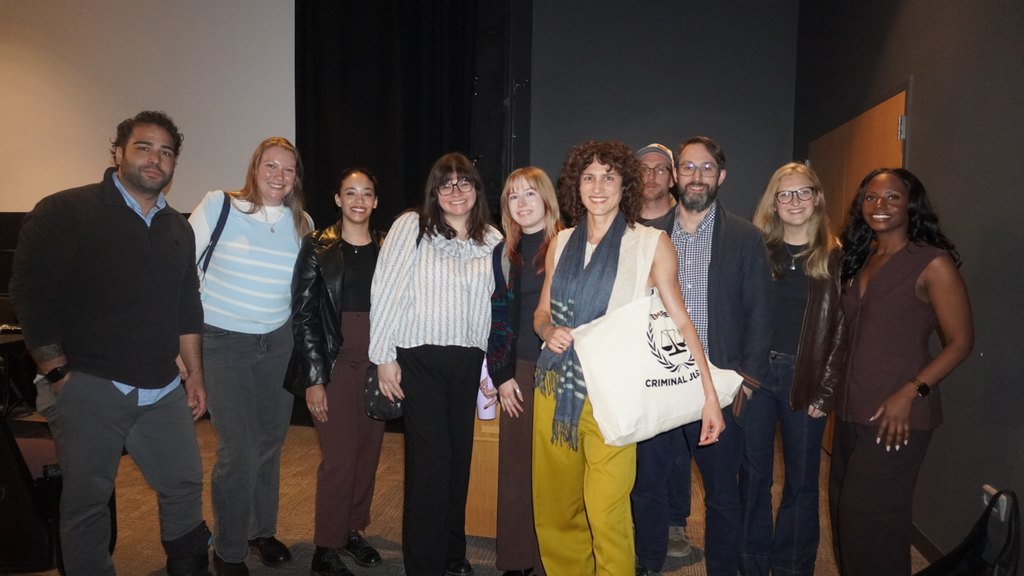
Issa Kohler-Hausmann poses with members of the Criminal Justice Department
Despite dispatching almost every discrimination challenge, neither courts nor commentators clearly defined what they were looking for evidence of. The paradigmatic definitions of discrimination are terminally indeterminate on this point, saying that intentional discrimination happens when candidates who differ by race but are otherwise similarly situated are treated differently. But must civilians be similarly situated but for race from the officer’s perspective, or from the researcher’s perspective? Neither courts nor social scientists made clear their assumption, and the ambiguity consistently cut against the people bringing the claims.
Now the script has flipped. In Students for Fair Admissions v. Harvard and in the Trump Administration’s enforcement campaign against universities, statistical disparities are treated as straightforward proof of intentional discrimination. The definitions and methods are the same, but the ambiguity now cuts the other way. The Administration treats any race-inflected interpretation of academic credentials as discriminatory in the admissions context, while in policing and immigration enforcement, race-inflected interpretations of an encounter are often accepted as a legitimate basis for different treatment.
The lecture argued that regressions, benchmarking analyses, and audit studies are evidence of discrimination only relative to a premise about who counts as similarly situated, given how race shapes people’s lives and opportunities. That premise cannot be read off the data, but it can and must be defended in light of what the data show about how race shapes credentials, records, and perceptions. She called for a principled equal protection that answers two questions explicitly: what race is as a social category, and what fair treatment requires in light of it. In her words, “The empirical study of criminal justice is well positioned to help answer both.”