
Photo by Kevin Haugh
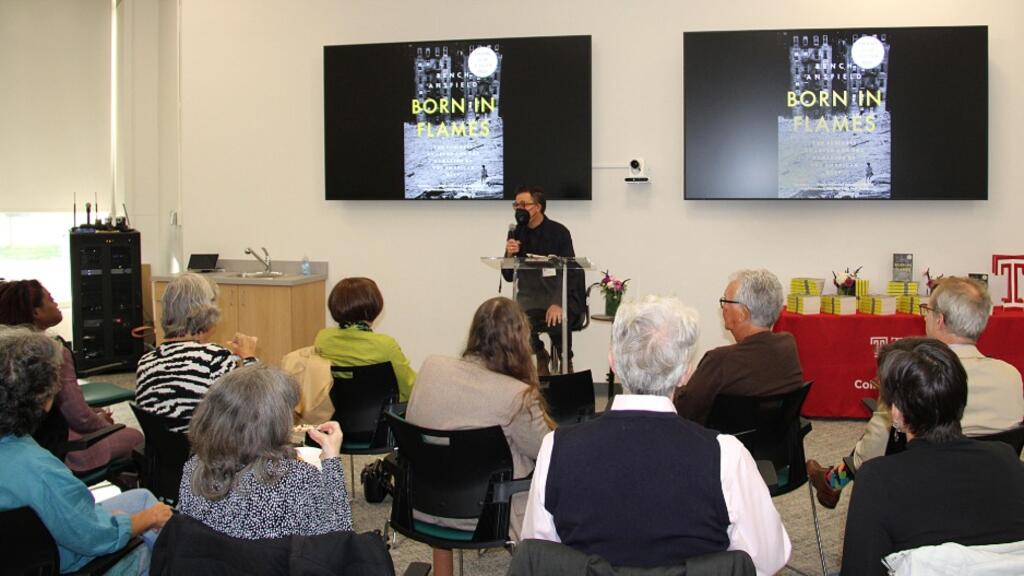
A number of Temple University’s most dedicated alumni and supporters gathered in Mazur Hall’s first-floor conference space on September 23 for An Evening With Author Bench Ansfield. The event featured a short reading and talk from Ansfield, an assistant professor in Temple’s History Department, from their award-winning book, Born in Flames: The Business of Arson and the Remaking of the American City.
The presentation served as the college’s annual welcome to members of its Conwell Circle, Temple’s premier donor recognition society. Born in Flames is an in-depth examination of the wave of arsons that forever transformed the Bronx in the 1970’s. As Dean Richard Deeg noted in his introductory remarks, Born in Flames has garnered hefty praise since its release, from glowing reviews in major publications to being named a 2026 Pulitzer Prize finalist.
While the book’s content is centered in New York, Ansfield explained that its origins unfolded in Philadelphia, during an eye-opening conversation with a neighbor about the 1985 MOVE bombing. “She said something that essentially changed my life,” recalled Ansfield. “She said it wasn’t just here—that fire was also used as a weapon in the Bronx, except it was landlords instead of police doing the burning.”
That remark stuck with Ansfield and eventually was the impetus for the ten years of research into the motivations and perpetrators behind the fires.
“There was very little scholarship on it,” said Ansfield. “The only people who remembered it were those who lived through it and who tended to be blamed for it. So the book, in a lot of ways, is animated by concerns for historical memory.”
Reading from the book, Ansfield explained that landlords orchestrated arsons on their own properties for exorbitant insurance payouts, a backdoor result of policies meant to protect neglected neighborhoods in the aftermath of 60s civil rights unrest.
“Fire insurance only entered these neighborhoods as a direct response from the federal government to the uprisings of the 1960s,” said Ansfield. “They set up these new state public-private state-sponsored insurance pools called FAIR (Fair Access to Insurance Requirements) plans, ostensibly as an anti-redlining measure. They were designed for “riot-prone” areas but were, in practice, more of a bailout for the insurance industry and inadvertently incentivized landlords to burn down their buildings.”
Selected excerpts from the book illustrated the impact the fires had on the Bronx and its inhabitants. Ansfield began with the story of Brick Series, an art exhibit of bricks painted by over 70 middle schoolers attempting to make sense of the nightly fires in their city, each inscribed with a child’s guess as to why the fires were taking place. Later, they told the true crime-inflected tale of landlord and serial insurance fraudster Carmine Lanny, and his personal torch, handyman Arturo “Popo” Vega, who would be forced to wear a wire and betray Lanny after getting caught during a badly bungled arson job.
Reading from the book’s final chapter, “We Went to Bed With Our Shoes on Every Night,” Ansfield talked about Bronxites watching the trail of fires blazing from night to night from their rooftops, the fires becoming so omnipresent that they were influencing New York’s booming disco scene (citing the Ohio Players’ “Fire” and “Disco Inferno” by the Trammps, among others).
“Tenants got in the habit of keeping a suitcase packed with their valuables near the front door,” read Ansfield. “Parents instructed their children to wear shoes to bed. Expulsion by fire became routine.”
Ansfield also shared anecdotes from the aftermath of the book’s release. In one, they were approached after reading the aforementioned final chapter at the Museum of the City of New York by a well-known historian who had grown up in the Bronx during fires.
“She was so pale. She had all these memories of being put to bed by her mom wearing her street clothes and, as an adult, she’d interpreted this as not being taken care of,” recalled Ansfield. “She knew the history, but she didn’t know it was such a common experience. To learn that it was not her individual experience, that this was actually something her mom was doing to keep her safe, was very emotional for both her and me.”
After the presentation, Ansfield took questions from the audience. When asked what they will be tackling next, the author answered that they are currently working on a project about the climate crisis: “It turns out I may have signed up for another ten years.”