
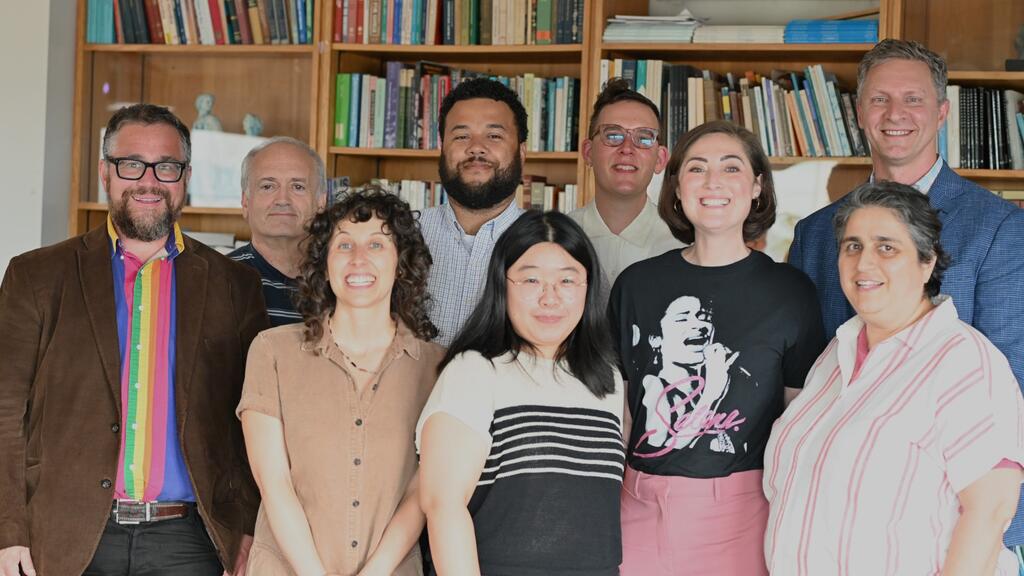
The 2026-2027 CHAT Fellows (left to right: Robert Rabiee, Isaac Clapper, Alexandra Schoolman, Nyron Crawford, Jiayu Yang, Bench Ansfield, Christina Baker, Wazhmah Osman, J. Christopher Upton)
For nearly 25 years, the Center for the Humanities at Temple (CHAT) has served as a hub for interdisciplinary research, dialogue and event programming. Through fellowships, public lectures and initiatives like its annual art contest, CHAT has fostered collaboration and community across the university, highlighting the vital importance of the humanities in our society.
As we enter a new season, CHAT is ready to announce its new annual theme and unveil this year’s crop of Fellows, who will present their research in an exciting series of talks throughout the semester.
CHAT’s 2026-2027 Theme
What do climate catastrophe, stone monuments, Indigenous hunting practices, refugee memory, conceptual art, and wax worms have in common? Materialities.
Inspired by Jane Bennett’s Vibrant Matter, CHAT’s 2026–2027 theme explores the many ways that matter—human and nonhuman—shapes the worlds we inhabit. This year’s Fellows approach that question from remarkably different perspectives, attending to bodies, environments, objects, infrastructures, sounds, technologies and even microorganisms.
These Materialities will come to life through the work of this year’s interdisciplinary cohort of faculty and graduate Fellows, brought together from across Temple’s schools and colleges to exchange ideas and share their ongoing research in a series of riveting open-to-the-public talks.
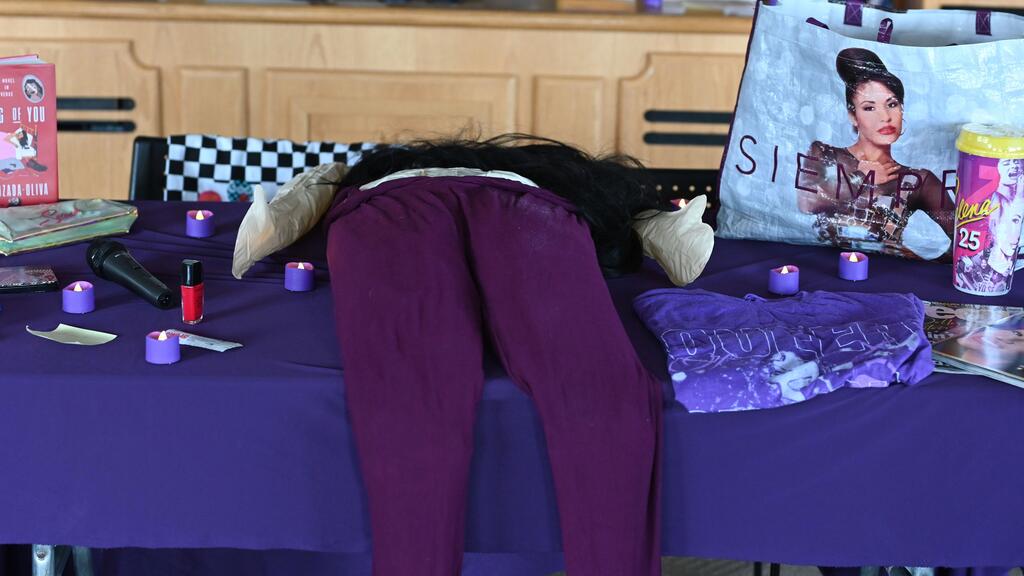
CHAT Director Christina Baker's talk featured materials from over a decade of research, including a replica of Selena’s iconic purple jumpsuit that Baker sewed herself when she first began this work.
CHAT kicked off this semester’s series with Program Director Christina Baker’s “Beautiful Dead Woman: Selena, Uncanny Desire, and the Politics of Memory,” delivered in Mazur Hall on August 31.
Backed by over a decade of research, Baker leveraged theoretical concepts from performance studies, the uncanny, and memory studies to contemplate the many ways singer-songwriter Selena Quintanilla continues to be invoked more than three decades after her death—and yet remains perpetually 23, preserved as an image of youth and perfection.
Read on to learn about the rest of this semester’s slate of CHAT talks, and meet the 2026-2027 CHAT Fellows behind them.
Graduate Fellows
Alexandra Schoolman (Department of Art History, Tyler School of Art and Architecture)
September 14, 2026. 3:30 PM, Mazur 821
“Groundwork: Alternative Pathways, Networks, and Sites of Resistance in Conceptualist Art from the Brazilian, Argentine, and Chilean Dictatorships, 1964–1990”
Schoolman examines how artists under South American dictatorships mobilized materials, environments, public space, gesture, sound, and performance to resist authoritarianism and imagine new ways of living.
Jiayu Yang (Documentary Arts and Visual Research, School of Theater, Film and Media Arts)
October 5, 2026. 3:30 PM, Mazur 821
“Toward a Metamorphosing Ontology: The Wax Worms Across Visual, Material, and Digital Articulations”
Yang traces wax worms across scientific, environmental, technological, and artistic worlds, asking how different forms of visualization and material intervention continually remake what these organisms are and what they might become.
Faculty Fellows
Nyron Crawford (Associate Professor of Political Science, College of Liberal Arts)
October 19, 2026. 3:30 PM, Mazur 821
“The Political Economy of Black Men: A Critical Policy Analysis”
Crawford examines how Black men’s encounters with the social safety net, child support, marijuana legalization, and the criminal legal system can generate political distrust, alienation, disengagement, and withdrawal.
Isaac Klapper (Professor of Mathematics and Biology, College of Science and Technology)
November 2, 2026. 3:30 PM, Mazur 821
“When Monuments Breathe: On Preservation and Decay”
Klapper approaches stone monuments as living, breathing objects, examining the microorganisms that inhabit their surfaces and how microbial life interacts with—and reshapes—its material environment.
J. Christopher Upton (Assistant Professor of Anthropology, College of Liberal Arts)
February 22, 2026. 3:30 PM, Mazur 821
“Jurisprudence of the Mountains: Ontologies, Ethics, and Jurisdictional Imaginaries of Indigenous Hunting on Formosa”
Upton examines Bunun hunting practices in Taiwan, exploring how mountains, animals, and hunting instruments participate in a living moral and political ecology shaped by ancestral rules, law, and Indigenous sovereignty.
Wazhmah Osman (Associate Professor of Media and Communication, Lew Klein College of Media and Communication)
March 15, 2026. 3:30 PM, Mazur 821
“Afghan Refugees and Media Makers in Exile Reflect on Imperial Remainders and the Afterlives of War”
Osman’s work-in-progress film explores Afghan refugees and media makers in exile, considering the material and psychic afterlives of war, migration, and U.S. empire across bodies, borders, and generations.
Bench Ansfield (Assistant Professor of History, College of Liberal Arts)
March 29, 2026. 3:30 PM, Mazur 821
Project: Climate Catastrophe and Property Insurance
Ansfield examines the material and affective life of climate catastrophe through property insurance, exploring how maps, data, infrastructure, risk models, and physical vulnerabilities transform environmental devastation—and fear—into financial value.