Student Life

Student Spotlight

The Q&A below features some of our outstanding current Economics students and their accomplishments. Read about some of our students and the diversity of options within the Economics major, internships and opportunities they are pursuing! 

Why did you decide to major in Economics? How have you stayed involved in the Economics program outside of classes?

I started college as a Statistics major because I really enjoy math, but I realized I wanted to apply it to real-world questions. After taking an upper-level economics course, I was drawn to how economics uses math to study a wide range of issues. I think economics has a lot of practical applications and I truly believe it connects to almost everything!

Outside of the classroom, I stay involved as president of the Women in Economics organization. I’m also working on a LAURA research project with Professor Solomon this semester. In the past, I’ve also been a Peer Teacher for Macro Principles.

Last summer, you participated in the American Economic Association Summer Program. Can you briefly describe the program?

The AEA Summer Program is an 8-week program that is meant to mimic the first year of a PhD program in Economics. I took 3 graduate-level economics courses and worked on an independent research project during the summer.  I also attended research conferences, connected with professional economists, and built a strong network with peers who share similar academic and research interests.

What have you gained from your participation in the AEA Summer Program?

I gained a strong set of technical and research skills from the program. I became very comfortable working in R through daily use on large, messy datasets, which significantly strengthened my data skills. The independent research project also helped me understand the full research process. 

Beyond technical skills, the program taught me resilience and adaptability. I faced several challenges during the research process and learned how to pivot and manage my time effectively. Most importantly, I built a strong network of peers and mentors through the program.

What are your career goals?

I know I want a career that is intellectually challenging. I enjoy working closely with economic research, so either conducting research myself or applying it to real-world problems is a goal of mine. I’m especially interested in work that directly impacts people, such as improving public systems, healthcare outcomes, or protecting consumers. Being able to see real-world impact from my work is very important to me.

What has been your favorite Economics course thus far?

This is a hard question. It would be a tie between Economics of Development and Growth and Econometrics. Development was the first class where I really got to see the applications of economics in a way that was incredibly meaningful to me. This is the class that definitely sparked my interest in research. I also really enjoyed Econometrics because it was cool to learn how statistics can be used to answer important economic questions.

Any final thoughts for prospective and current Economics majors and minors?

Economics is so broad, so I recommend taking as many electives as possible and exploring a wide variety of them. Also, get involved outside of the classroom. Whether it be a club or research, you never know what you might find exciting!

Why did you decide to major in Economics? How have you stayed involved in the Economics program outside of classes?

I wanted to understand how public policy affected citizens' wellbeing in a more quantifiable way than just political theory. Economics offered me the framework through which to study policy decisions and make recommendations based on data and empirical analyses. Beyond the classroom, I am involved in the Temple Economics Society, with whom I travel to an Economic Policy Conference in DC every Spring. I serve as a Peer Assistant with the department, aiding students in introductory courses, the Women in Economics club, and the Omicron Delta Epsilon honors society.

You recently spent a semester at TUJ. How was it and what did you gain from your time there?

I absolutely loved the semester I spent at TUJ. The opportunity to live in and experience a different culture is priceless. I was able to take classes dealing in international monetary systems and geopolitics and gained a new perspective on international relations. TUJ has wonderful career development and networking opportunities, even for those studying abroad.

You interned with the Philadelphia Housing Authority in the Summer of 2025. Tell us about your experience there.

At PHA I worked on a data analytics project for the Office of Public Safety, analyzing crime data and local housing characteristics to model trends in crime. My department offered a wonderful work environment. It was a very closeknit team and my colleagues wer more than willing to answer questions and aid in the adjustment process. I would recommend PHA to those who are motivated to do good in their communities.

What are your career goals?

I would love to explore a career in Public Policy research, working at an independent think tank or an international relations institute. I plan to pursue a research role after graduation and then apply for graduate school from there.

What has been your favorite Economics course thus far?

One of my favorite courses was an upper-level elective called the Economics of Development & Growth with Dr. Das which analyzes developing nations and communities and how various growth and development strategies affect those communities. I was exposed to many different economic models, research methods, and experimental ideas in this class. I loved that economists devised methods to measure and model complex concepts like gender-based freedom, household decision-making power, childhood health, and human functions and capabilities.

Any final thoughts for prospective and current Economics majors and minors?

Whatever you THINK Economics is, think bigger and broader. Economics is a framework through which you view the world. It is how you make choices, how you analyze problems, and devise solutions. It can be applied to a scenario as small as buying lunch or as big as reducing global poverty. If you are logical, enjoy problem-solving and combining qualitative and quantitative skills, this is the major for you.

Temple Economics Society (TES)

The Temple Economics Society (TES) is the student professional organization for economics majors and is open to all students interested in economics. For more information, please see the TES web site or attend one of the weekly meetings (Fridays at noon in Alter Hall 239).

Temple Data Analytics Club (TDAC)

The Temple Data Analytics Club (TDAC) welcomes all students to delve into immersive experiences in the data-driven world. Students engage in hands-on Python workshops and real-world projects to enhance their skills. Join us for our weekly meetings on Mondays at noon in Gladfelter Hall 231B for networking and discussions. For additional information, contact the founder and advisor, .

Women in Economics (WiE)

Women in Economics (WiE) is a student organization that facilitates an environment to empower women in the field of economics. Any female student who is interested in economics, regardless of whether they are an economics major or not, is welcome to join. For additional information, contact the advisor, .

Omicron Delta Epsilon (ODE)

Omicron Delta Epsilon (ODE) is one of the largest academic honor societies worldwide. It recognizes and honors outstanding achievement in Economics and creates closer ties between Economics students and faculty. Students may apply for admission to ODE if they have completed at least 12 credits in Economics and a 3.0 GPA overall and in their Economics classes. For more information, contact .

Economics Internship Opportunities

The College of Liberal Arts recommends all students pursue internships to gain experiential learning that rounds out the skills and knowledge they acquire in the classroom. Economics students have access to a wealth of exciting internship opportunities in and around Philadelphia that will benefit them greatly in their careers.

Economics Majors have access to internship opportunities through the Economics student organization, The Economics Society (TES). Information on TES is available on their website. You can contact them at: 

Project-based Internships

Projects allow an intern to apply economic principles to everyday organizational and business problems. Businesses need to grow to survive and projects are a focused way to build the economic platform that ensures that growth and sustainability.

Bureau of Labor Statistics Internships

The economists from the Bureau of Labor Statistics (“BLS”) teach our interns all about the data and statistics collected and reported by the BLS. This includes data on unemployment, inflation and wages. Interns learn how to utilize and interpret this data and will create a research project and presentation based on BLS data. The BLS Internship meets once per week on the main Temple campus.

First Up Internships

First Up supports and advocates for Pre-Kindergarten providers in the City of Philadelphia. There are approximately 3,000 of these private Pre-K providers in Philadelphia. Interns will be trained by First Up to aid these Pre-K providers in creating operating budgets and in finding additional sources of revenue. Additionally, Interns can participate in research programs that support the lobbying efforts of First Up. The First Up Internship has regular meetings at their offices in Center City.

Econ%20Policy%20Conference_0.png

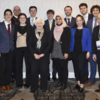
Temple Economics Society with Secretary of the Treasury Janet Yellen (center) in DC. Temple instructors and Econ PhD students Herbert Taylor (far left) and Christopher Swann (far right)

Economics Scholarships and Awards

Economics degree and certificate students are encouraged to apply for some of the hundreds of scholarships and awards opportunities made available by Temple University, the College of Liberal Arts and external sources. Click the link for your program below to explore options for saving on tuition relative to that program.